A Letter to Someone Who Would Benefit From Reading the Kite Runner
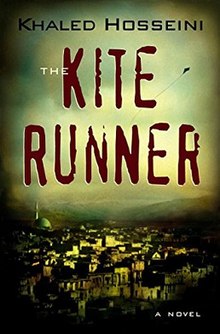 First edition encompass (US hardback) | |
| Author | Khaled Hosseini |
|---|---|
| Encompass artist | Honi Werner |
| Country | The states |
| Language | English |
| Genre |
|
| Publisher | Riverhead Books |
| Publication appointment | May 29, 2003 |
| Pages | 371 |
| ISBN | 1-57322-245-3 |
| OCLC | 51615359 |
| Dewey Decimal | 813/.6 21 |
| LC Class | PS3608.O832 K58 2003 |
The Kite Runner is the start novel by Afghan-American author Khaled Hosseini.[i] Published in 2003 by Riverhead Books, it tells the story of Amir, a immature boy from the Wazir Akbar Khan district of Kabul. The story is set confronting a properties of tumultuous events, from the autumn of Afghanistan'due south monarchy through the Soviet invasion, the exodus of refugees to Islamic republic of pakistan and the United States, and the rise of the Taliban authorities.
Hosseini has commented that he considers The Kite Runner to exist a begetter-son relationship story, emphasizing the familial aspects of the narrative, an element that he continued to use in his later works.[2] Themes of guilt and redemption feature prominently in the novel,[3] with a pivotal scene depicting an human action of sexual attack that happens against Hassan, Amir's friend, that Amir fails to prevent, which leads to the end of their friendship. The latter half of the book centers on Amir'due south attempts to atone for this transgression by rescuing Hassan's son 2 decades later on.
The Kite Runner became a bestseller afterwards being printed in paperback and was popularized in volume clubs. It appeared on the New York Times bestseller list for over two years,[4] with over seven meg copies sold in the United states.[five] Reviews were generally positive, though parts of the plot drew significant controversy in Afghanistan. A number of adaptations were created following publication, including a 2007 film of the same name, several stage performances, and a graphic novel. The novel is likewise available in a multi-CD audiobook read by the author.
Limerick and publication [edit]

Khaled Hosseini worked as a medical internist at Kaiser Infirmary in Mountain View, California for several years before publishing The Kite Runner.[iii] [6] [7] In 1999, Hosseini learned through a news report that the Taliban had banned kite flying in Afghanistan,[8] a brake he constitute particularly cruel.[9] The news "struck a personal chord" for him, as he had grown up with the sport while living in Afghanistan. He was motivated to write a 25-folio short story about ii boys who fly kites in Kabul.[8] Hosseini submitted copies to Esquire and The New Yorker, both of which rejected it.[9] He rediscovered the manuscript in his garage in March 2001 and began to expand it to novel format at the proposition of a friend.[8] [9] According to Hosseini, the narrative became "much darker" than he originally intended.[viii] His editor, Cindy Spiegel, "helped him rework the final tertiary of his manuscript", something she describes equally relatively common for a first novel.[nine]
As with Hosseini's subsequent novels, The Kite Runner covers a multigenerational period and focuses on the human relationship betwixt parents and their children.[2] The latter was unintentional; Hosseini developed an involvement in the theme while in the process of writing.[ii] He afterwards divulged that he frequently came up with pieces of the plot by drawing pictures of it.[seven] For example, he did non decide to make Amir and Hassan brothers until later on he had "doodled information technology".[7]
Like Amir, the protagonist of the novel, Hosseini was born in Afghanistan and left the country equally a youth, not returning until 2003.[x] Thus, he was oft questioned about the extent of the autobiographical aspects of the book.[9] In response, he said, "When I say some of information technology is me, and so people wait unsatisfied. The parallels are pretty obvious, merely ... I left a few things ambiguous because I wanted to drive the volume clubs crazy."[9] Having left the state around the time of the Soviet invasion, he felt a certain amount of survivor'due south guilt: "Whenever I read stories about Afghanistan my reaction was ever tinged with guilt. A lot of my childhood friends had a very hard fourth dimension. Some of our cousins died. One died in a fuel truck trying to escape Afghanistan [an incident that Hosseini fictionalizes in The Kite Runner]. Talk about guilt. He was one of the kids I grew up with flying kites. His begetter was shot."[2] [11] Regardless, he maintains that the plot is fictional.[8] Later, when writing his 2nd novel, A Thousand Splendid Suns (then titled Dreaming in Titanic Metropolis), Hosseini remarked that he was happy that the master characters were women equally it "should put the end to the autobiographical question once and for all."[9]
Riverhead Books published The Kite Runner, ordering an initial printing of 50,000 copies in hardback.[nine] [12] It was released on May 29, 2003, and the paperback edition was released a yr afterwards.[nine] [13] Hosseini took a year-long absence from practicing medicine to promote the book, signing copies, speaking at various events, and raising funds for Afghan causes.[9] Originally published in English, The Kite Runner was later translated into 42 languages for publication in 38 countries.[xiv] In 2013, Riverhead released the 10th ceremony edition with a new golden-rimmed cover and a foreword by Hosseini.[15] That aforementioned year, on May 21, Khaled Hosseini published another book chosen And the Mountains Echoed.
Plot summary [edit]
Part I [edit]

Wazir Akbar Khan neighborhood in Kabul, setting of Part I
Amir, a well-to-do Pashtun boy, and Hassan, a Hazara boy who is the son of Ali, Amir's father'southward servant, spend their days kite fighting in the hitherto peaceful city of Kabul. Flying kites was a mode to escape the horrific reality the two boys were living in. Hassan is a successful "kite runner" for Amir; he knows where the kite will country without watching it. Both boys are motherless: Amir'south mother died in childbirth, while Hassan's female parent, Sanaubar, simply abased him and Ali. Amir's male parent, a wealthy merchant Amir affectionately refers to as Baba, loves both boys. He makes a bespeak of buying Hassan exactly the same things every bit Amir, to Amir's badgerer. He fifty-fifty pays to accept Hassan's cleft lip surgically corrected. On the other hand, Baba is often critical of Amir, considering him weak and lacking in courage, fifty-fifty threatening to physically punish him when he complains near Hassan. Amir finds a kinder fatherly figure in Rahim Khan, Baba's closest friend, who understands him and supports his interest in writing, whereas Baba considers that involvement to be worthy merely of females. In a rare moment, when Amir is sitting on Baba'southward lap rather than existence shooed away as a bother, he asks why his father drinks booze which is forbidden past Islam. Baba tells him that the Mullahs are hypocrites and the only real sin is theft which takes many forms.
Assef, an older male child with a sadistic gustatory modality for violence, mocks Amir for socializing with an Hazara which, according to him, is an inferior race whose members belong only in Hazarajat. Assef is himself only half Pashtun, having a High german mother and a typical blond-haired blue-eyed German language appearance. One day, he prepares to attack Amir with contumely knuckles, just Hassan defends Amir, threatening to shoot out Assef'due south middle with his slingshot. Assef backs off but swears to take revenge one mean solar day.
One triumphant day, Amir wins the local kite-fighting tournament and finally earns Baba's praise. Hassan runs for the terminal cutting kite, a great bays, saying to Amir, "For you, a k times over." Notwithstanding, later finding the kite, Hassan encounters Assef in an alleyway. Hassan refuses to surrender the kite, and Assef severely beats him and rapes him. Amir witnesses the human activity simply is too scared to intervene. He knows that if he fails to bring dwelling house the kite, Baba would exist less proud of him. He feels incredibly guilty but knows his cowardice would destroy any hopes for Baba'due south affections, and then he keeps quiet nigh the incident. Subsequently, Amir keeps afar from Hassan; his feelings of guilt forestall him from interacting with the boy. Hassan's mental and concrete well-beingness begin to deteriorate.
Amir begins to believe that life would be easier if Hassan were not around, so he plants a spotter and some money under Hassan's mattress in the hope that Baba volition make him exit; Hassan falsely confesses when confronted by Baba. Although Baba believes "in that location is no act more wretched than stealing", he forgives him. To Baba's sorrow, Hassan and Ali leave anyway, because Hassan has told Ali what happened to him. Amir is freed of the daily reminder of his cowardice and expose, merely he even so lives in their shadow.
Part Ii [edit]
In 1979, five years later on, the Soviet Matrimony militarily intervened in Afghanistan. Baba and Amir escape to Peshawar, Pakistan, and then to Fremont, California, where they settle in a run-downwards apartment. Baba begins piece of work at a gas station. After graduating from high school, Amir takes classes at San Jose Land University to develop his writing skills. Every Sun, Baba and Amir make extra money selling used goods at a flea marketplace in San Jose. There, Amir meets fellow refugee Soraya Taheri and her family. Baba is diagnosed with terminal cancer but is still capable of granting Amir ane concluding favor: he asks Soraya'south father's permission for Amir to marry her. He agrees and the two ally. Shortly thereafter Baba dies. Amir and Soraya settle down in a happy marriage, but to their sorrow, they learn that they cannot take children.
Amir embarks on a successful career as a novelist. Fifteen years afterwards his wedding, Amir receives a call from his father's best friend (and his babyhood father figure) Rahim Khan. Khan, who is dying, asks Amir to visit him in Peshawar. He enigmatically tells Amir, "There is a way to be skilful again."
Part 3 [edit]
From Rahim Khan, Amir learns that Hassan and Ali are both dead. Ali was killed past a state mine. Hassan and his wife were killed afterward Hassan refused to allow the Taliban to confiscate Baba and Amir's house in Kabul. Rahim Khan further reveals that Ali was sterile and was not Hassan'south biological father. Hassan was really the son of Sanaubar and Baba, making him Amir'southward half brother. Finally, Khan tells Amir that the reason he has called Amir to Pakistan is to ask him to rescue Hassan's son, Sohrab, from an orphanage in Kabul.
Amir searches for Sohrab, accompanied by Farid, an Afghan taxi driver and veteran of the war with the Soviets. They learn that a Taliban official comes to the orphanage ofttimes, brings cash, and usually takes a girl abroad with him. Occasionally he chooses a boy, recently Sohrab. The orphanage managing director tells Amir how to find the official, and Farid secures an appointment at his habitation by claiming to accept "personal concern" with him.
Amir meets the Taliban leader, who reveals himself as Assef. Sohrab is existence kept at Assef'south house as a dancing male child. Assef agrees to relinquish him if Amir can beat out him in a fight. Assef then desperately beats Amir, breaking several basic, until Sohrab uses a slingshot to fire a brass brawl into Assef'due south left eye. Sohrab helps Amir out of the house, where he passes out and wakes up in a hospital.
Amir tells Sohrab of his plans to take him back to America and possibly adopt him. However, American authorities need bear witness of Sohrab's orphan condition. Amir tells Sohrab that he may have to go back to an orphanage for a little while as they have encountered a problem in the adoption procedure, and Sohrab, terrified nigh returning to an orphanage, attempts suicide. Amir eventually manages to take him back to the United States. Subsequently his adoption, Sohrab refuses to interact with Amir or Soraya until Amir reminisces about Hassan and kites and shows off some of Hassan's tricks. In the cease, Sohrab simply gives a lopsided smiling, simply Amir takes it with all his middle as he runs the kite for Sohrab, maxim, "For you, a thousand times over."
Characters [edit]
Protagonist [edit]
- Amir (named Amir Qadiri in 2007 picture show adaptation, surname is not given in volume) is the protagonist and narrator of the novel. Khaled Hosseini acknowledged that the graphic symbol is "an unlikable coward who failed to come to the assistance of his best friend" for much of the duration of the story; consequently, Hosseini chose to create sympathy for Amir through circumstances rather than the personality he was given until the terminal third of the book.[16] Born into a Pashtun family in 1963, his mother died while giving birth to him. Equally a child, he enjoys storytelling and is encouraged past Rahim Khan to go a well-known writer. At age 18, he and his begetter flee to America following the Soviet Armed forces invasion of Transitional islamic state of afghanistan, where he pursues his dream of being a writer.
Main Characters [edit]
- Hassan is Amir'southward closest childhood friend. He is described equally having a china doll face, green eyes, and a harelip. Hosseini regards him every bit a flat character in terms of development; he is "a lovely guy and you root for him and you lot love him but he'southward not complicated".[17]
- Baba is Amir's male parent and a wealthy man of affairs who aids the customs by establishing businesses for others and building a new orphanage. He is the biological father of Hassan, a fact he hides from both of his children, and seems to favor him over Amir. Baba does not endorse the extremist religious views of the clerics at Amir's schoolhouse. After fleeing to America, he works at a gas station. He dies from cancer in 1987, shortly later on Amir and Soraya'south wedding.
- Ali is Baba'due south servant, a Hazara believed to be Hassan'southward father. He was adopted every bit a child past Baba'south father after his parents were killed by a drunk commuter. Before the events of the novel, Ali had been struck with polio, rendering his right leg useless. Because of this, Ali is constantly tormented by children in the boondocks. He is later on killed by a state mine in Hazarajat.
- Rahim Khan is Baba's loyal friend and business partner.
- Soraya is a immature Afghan woman whom Amir meets and marries in the U.s.. Hosseini originally scripted the character as an American adult female, but he afterwards agreed to rewrite her equally an Afghan immigrant after his editor did non notice her groundwork believable for her role in the story.[xviii] The alter resulted in an extensive revision of Part 3.[18] In the final typhoon, Soraya lives with her parents, Afghan general Taheri and his married woman, and wants to get an English teacher. Before meeting Amir, she ran away with an Afghan boyfriend in Virginia, which, according to Afghan civilisation, made her unsuitable for marriage. Because Amir is unwilling to confront his own past deportment, he admires Soraya for her courage in albeit to, and moving beyond, her past mistakes.
- Sohrab is the son of Hassan, who is captured by Assef after Hassan and his married woman are killed. Sohrab is eventually rescued by Amir and taken to live in America equally Amir and Soraya's adopted son
Antagonists [edit]
- Assef is the main antagonist of the novel. He is the son of a Pashtun male parent and a German female parent, and believes that Pashtuns are superior to Hazaras, although he himself is not a full Pashtun. Equally a teenager, he is a neighborhood peachy and is enamored with Hitler and Nazism. He is described as a "sociopath" by Amir. He rapes Hassan to get revenge on Amir. As an adult, he joins the Taliban and sexually abuses Hassan's son, Sohrab and other children of Sohrab's orphanage.
Secondary Characters [edit]
- Sanaubar is Ali's wife and the female parent of Hassan. Shortly after Hassan'south birth, she runs away from dwelling and joins a group of traveling dancers. She later returns to Hassan in his adulthood. To brand up for her fail, she provides a grandmother effigy for Sohrab, Hassan'due south son.
- Farid is a taxi driver who is initially abrasive toward Amir, simply later on befriends him. Ii of Farid's seven children were killed by a land mine, a disaster which mutilated three fingers on his left hand and also took some of his toes. After spending a night with Farid'south brother's impoverished family, Amir hides a bundle of money under the mattress to help them.
- General Taheri is the father of Soraya, a former military full general in the Afghan Army. He has a very traditionalistic view on life, despite being well meaning, and is obsessed with honor and society'due south impression on him and his family, which causes small-scale conflicts betwixt him and Soraya, and later, to some extent Amir. However these are very minor conflicts, and all is fabricated up later.
- Jamila Taheri Soraya's female parent, who dotes on Amir after Amir marries Soraya
Themes [edit]
Because its themes of friendship, betrayal, guilt, redemption and the uneasy love between fathers and sons are universal, and not specifically Afghan, the book has been able to attain across cultural, racial, religious and gender gaps to resonate with readers of varying backgrounds.
—Khaled Hosseini, 2005[3]
Khaled Hosseini identifies a number of themes that appear in The Kite Runner, but reviewers have focused on guilt and redemption.[9] [11] [xix] As a child, Amir fails to salve Hassan in an act of cowardice and afterwards suffers from an all-consuming guilt. Even after leaving the country, moving to America, marrying, and becoming a successful writer, he is unable to forget the incident. Hassan is "the all-sacrificing Christ-figure, the one who, even in death, calls Amir to redemption".[19] Following Hassan's expiry at the hands of the Taliban, Amir begins to redeem himself through the rescue of Hassan's son, Sohrab.[20] Hosseini draws parallels during the search for Sohrab to create an impression of poetic justice; for case, Amir sustains a carve up lip afterwards being severely browbeaten, similar to Hassan's harelip.[twenty] Despite this, some critics questioned whether the protagonist had fully redeemed himself.[21]
Amir's motivation for the childhood expose is rooted in his insecurities regarding his human relationship with his father.[22] The relationship betwixt parents and their children features prominently in the novel, and in an interview, Hosseini elaborated:
Both [The Kite Runner and A 1000 Splendid Suns] are multigenerational, and so the relationship between parent and child, with all of its manifest complexities and contradictions, is a prominent theme. I did not intend this, but I am keenly interested, it appears, in the way parents and children love, disappoint, and in the end award each other. In one way, the ii novels are corollaries: The Kite Runner was a father-son story, and A K Fantabulous Suns can be seen every bit a mother-girl story.[2]
When adapting The Kite Runner for the theatre, Director Eric Rose stated that he was fatigued into the narrative by the "themes of betraying your best friend for the love of your begetter", which he compared to Shakespearean literature.[23] Throughout the story, Amir craves his begetter'south amore;[22] his father, in turn, loves Amir only favors Hassan,[20] going as far equally to pay for plastic surgery to repair the latter's crevice lip.[24]
Critical reception [edit]

Showtime Lady Laura Bush with Khaled Hosseini (starting time and second to the left); Bush praised The Kite Runner equally "actually great".[25]
In the outset 2 years following its publication, over lxx,000 hardback copies of The Kite Runner were sold along with 1,250,000 paperback copies.[iii] Though the book sold well in hardback, "Kite Runner's popularity didn't really begin to soar until [2004] when the paperback edition came out, which is when book clubs began picking it up."[9] It started appearing on best seller lists in September 2004 and became a New York Times bestseller in March 2005,[3] maintaining its place on the list for two years.[four] By the publication of Khaled Hosseini'southward third novel in 2013, over seven million copies had been sold in the United states of america.[5] The book received the South African Boeke Prize in 2004. Information technology was voted the Reading Grouping Book of the Yr for 2006 and 2007 and headed a listing of 60 titles submitted by entrants to the Penguin/Orange Reading Group prize (United kingdom).[26] [27]
Critically, the book was well-received, albeit controversial. Erika Milvy from Salon praised it as "beautifully written, startling and middle wrenching".[28] Tony Sims from Wired Magazine wrote that the book "reveals the beauty and agony of a tormented nation as it tells the story of an improbable friendship between two boys from opposite ends of lodge, and of the troubled simply enduring relationship between a father and a son".[29] Amelia Hill of The Observer opined, "The Kite Runner is the shattering first novel past Khaled Hosseini" that "is simultaneously devastating and inspiring."[22] A similarly favourable review was printed in Publishers Weekly.[13] Marketing manager Melissa Mytinger remarked, "It'south simply an excellent story. Much of it based in a earth we don't know, a world nosotros're barely beginning to know. Well-written, published at the 'right time' by an author who is both mannerly and thoughtful in his personal appearances for the book."[3] Indian-American actor Aasif Mandvi agreed that the book was "amazing storytelling. ... Information technology's about human being beings. It's about redemption, and redemption is a powerful theme."[9] First Lady Laura Bush commended the story as "really great".[25] Said Tayeb Jawad, the 19th Afghan ambassador to the United states, publicly endorsed The Kite Runner, maxim that the volume would help the American public to better sympathize Afghan society and culture.[9]
Edward Hower from The New York Times analyzed the portrayal of Afghanistan earlier and after the Taliban:
Hosseini's depiction of pre-revolutionary Afghanistan is rich in warmth and humour but also tense with the friction between the nation's dissimilar ethnic groups. Amir'south father, or Baba, personifies all that is reckless, courageous and big-headed in his dominant Pashtun tribe ... The novel's canvas turns dark when Hosseini describes the suffering of his state under the tyranny of the Taliban, whom Amir encounters when he finally returns home, hoping to help Hassan and his family. The final tertiary of the volume is full of haunting images: a man, desperate to feed his children, trying to sell his bogus leg in the market; an adulterous couple stoned to death in a stadium during the halftime of a football lucifer; a rouged immature boy forced into prostitution, dancing the sort of steps one time performed by an organ grinder'due south monkey.[24]
Meghan O'Rouke, Slate Magazine's culture critic and advisory editor, ultimately found The Kite Runner mediocre, writing that "this is a novel simultaneously striving to deliver a large-calibration informative portrait and to stage a small-scale redemptive drama, but its therapeutic allegory of recovery can only undermine its realist ambitions. People experience their lives against the backdrop of their civilization, and while Hosseini wisely steers clear of only exoticizing Transitional islamic state of afghanistan as a monolithically foreign identify, he does so much piece of work to make his novel emotionally accessible to the American reader that there is almost no room, in the end, for the states to consider for long what might differentiate Afghans and Americans."[25] Sarah Smith from The Guardian thought the novel started out well merely began to stammer towards the stop. She felt that Hosseini was likewise focused on fully redeeming the protagonist in Role 3 and in doing then created too many unrealistic coincidences that allowed Amir the opportunity to disengage his past wrongs.[20]
Controversies [edit]
The American Library Association reported that The Kite Runner was one of its near-challenged books of 2008, with multiple attempts to remove it from libraries due to its "offensive linguistic communication, sexually explicit [content], and unsuit[ability for] age grouping."[30] Afghan American readers were particularly disquisitional towards the depiction of Pashtuns equally oppressors and Hazaras as the oppressed.[11] Hosseini responded in an interview, "They never say I am speaking almost things that are untrue. Their beefiness is, 'Why practise you have to talk about these things and embarrass us? Don't you lot love your state?'"[xi] Afghan-Australian announcer Emran Feroz, however, criticized the novel for oversimplifying ethnic relations in Afghanistan and portraying Pashtuns in general in an overly negative light. Feroz further expressed concern that works past Hosseini, who was raised in a culturally Tajik context rather than Pashtun, would prevent western readers from developing a more nuanced view of Afghanistan.[31]
The film generated more than controversy through the 30-2d rape scene, with threats made against the child actors, who originated from Transitional islamic state of afghanistan.[28] Zekeria Ebrahimi, the 12-yr-old actor who portrayed Amir, had to be removed from school later his Hazara classmates threatened to impale him,[32] and Paramount Pictures was eventually forced to relocate three of the children to the United Arab Emirates.[28] Afghanistan'due south Ministry of Civilisation banned the movie from distribution in cinemas or DVD stores, citing the possibility that the motion-picture show's ethnically charged rape scene could incite racial violence within Afghanistan.[33]
Adaptations [edit]
Film [edit]

Iv years after its publication, The Kite Runner was adapted as a move motion picture starring Khalid Abdalla as Amir, Homayoun Ershadi equally Baba, and Ahmad Khan Mahmoodzada as Hassan. It was initially scheduled to premiere in Nov 2007, just the release date was pushed back six weeks to evacuate the Afghan child stars from the land after they received death threats.[34] Directed past Marc Forster and with a screenplay by David Benioff, the film won numerous awards and was nominated for an Academy Award, the BAFTA Film Laurels, and the Critics Choice Award in 2008.[35] While reviews were generally positive, with Entertainment Weekly deeming the final product "pretty good",[36] the delineation of ethnic tensions and the controversial rape scene drew outrage in Afghanistan.[34] Hangama Anwari, the child rights commissioner for the Transitional islamic state of afghanistan Independent Human Rights Commission, commented, "They should not play around with the lives and security of people. The Hazara people will take it as an insult."[34]
Hosseini was surprised by the extent of the controversy acquired by the rape scene and said that Afghan actors would non take been cast had studios known that their lives would be threatened.[28] He believed that the scene was necessary to "maintain the integrity" of the story, as a physical assault past itself would not accept afflicted the audience as much.[28]
Other [edit]
The novel was commencement adapted to the stage in March 2007 past Bay Area playwright Matthew Spangler where it was performed at San Jose State University.[37] Two years later, David Ira Goldstein, artistic manager of Arizona Theater Company, organized for it to exist performed at San Jose Repertory Theatre. The play was produced at Arizona Theatre Company in 2009, Player's Theatre of Louisville and Cleveland Play House in 2010, and The New Repertory Theatre of Watertown, Massachusetts in 2012. The theatre adaption premiered in Canada as a co-production between Theatre Calgary and the Citadel Theatre in January 2013. In April 2013, the play premiered in Europe at the Nottingham Playhouse, with Ben Turner acting in the atomic number 82 function.[38]
Hosseini was approached past Piemme, his Italian publisher, about adapting The Kite Runner to a graphic novel in 2011. Having been "a fan of comic books since babyhood", he was open to the idea, believing that The Kite Runner was a good candidate to be presented in a visual format.[29] Fabio Celoni provided the illustrations for the projection and regularly updated Hosseini on his progress before its release in September of that twelvemonth.[29] The latter was pleased with the final product and said, "I believe Fabio Celoni's work vividly brings to life not merely the mountains, the bazaars, the city of Kabul and its kite-dotted skies, but also the many struggles, conflicts, and emotional highs and lows of Amir's journey."[29]
See also [edit]
- 16 Days in Afghanistan listed as a reference film in Kite Runner's Written report guide[39]
- A Thousand Splendid Suns (Hosseini's second novel)
References [edit]
- ^ Noor, R.; Hosseini, Khaled (September–December 2004). "The Kite Runner". Earth Literature Today. 78 (3/4): 148. doi:10.2307/40158636. JSTOR 40158636.
- ^ a b c d e "An interview with Khaled Hosseini". Book Browse. 2007. Retrieved July 31, 2013.
- ^ a b c d e f Guthmann, Edward (March 14, 2005). "Before 'The Kite Runner,' Khaled Hosseini had never written a novel. But with word of rima oris, book sales have taken off". San Francisco Relate . Retrieved July 30, 2013.
- ^ a b Italie, Hillel (October 29, 2012). "'Kite Runner' author to debut new novel next yr". NBC News. Archived from the original on December 19, 2013. Retrieved July 31, 2013.
- ^ a b "Siblings' Separation Haunts In 'Kite Runner' Author's Latest". NPR. May xix, 2013. Retrieved August 3, 2013.
- ^ Jain, Saudamini (May 24, 2013). "Encompass STORY: the Afghan story teller Khaled Hosseini". Hindustan Times. Archived from the original on March 12, 2014. Retrieved July 31, 2013.
- ^ a b c Miller, David (June 7, 2013). "Khaled Hosseni author of Kite Runner talks about his mistress: Writing". Loveland Magazine. Archived from the original on Baronial 31, 2013. Retrieved July 31, 2013.
- ^ a b c d e "'Kite Runner' Writer On His Childhood, His Writing, And The Plight Of Afghan Refugees". Radio Free Europe. June 21, 2012. Retrieved July xxx, 2013.
- ^ a b c d east f thou h i j thousand fifty chiliad n Wilson, Craig (April 18, 2005). "'Kite Runner' catches the current of air". The states Today . Retrieved July 30, 2013.
- ^ Grossman, Lev (May 17, 2007). "The Kite Runner Author Returns Home". Time Magazine . Retrieved April nine, 2021.
- ^ a b c d Young, Lucie (May 19, 2007). "Despair in Kabul". Telegraph.co.uk. Archived from the original on 2022-01-12. Retrieved July 31, 2013.
- ^ Mehta, Monica (June half dozen, 2003). "The Kite Runner". Entertainment Weekly . Retrieved August eleven, 2013.
- ^ a b "The Kite Runner". Publishers Weekly. May 12, 2003. Retrieved August 1, 2013.
- ^ Tonkin, Boyd (February 28, 2008). "Is the Arab world ready for a literary revolution?". The Independent . Retrieved August eleven, 2013.
- ^ Deutsch, Lindsay (February 28, 2013). "Book Fizz: 'Kite Runner' celebrates 10th anniversary". U.s. Today . Retrieved Baronial 11, 2013.
- ^ Kakutani, Michiko (May 29, 2007). "A Woman's Lot in Kabul, Lower Than a Firm Cat's". The New York Times . Retrieved August 2, 2013.
- ^ Hoby, Hermione (May 31, 2013). "Khaled Hosseini: 'If I could become dorsum now, I'd take The Kite Runner apart'". The Guardian . Retrieved August 1, 2013.
- ^ a b Wyatt, Edward (December 15, 2004). "Wrenching Tale by an Afghan Immigrant Strikes a Chord". The New York Times . Retrieved August 2, 2013.
- ^ a b Rankin-Dark-brown, Maria (January 7, 2008). "The Kite Runner: Is Redemption Truly Free?". Spectrum Magazine . Retrieved August 1, 2013.
- ^ a b c d Smith, Sarah (Oct 3, 2003). "From harelip to split lip". The Guardian . Retrieved August 1, 2013.
- ^ Thompson, Harvey (March 25, 2008). "The Kite Runner: the Afghan tragedy goes unexplained". WSWS . Retrieved Baronial ane, 2013.
- ^ a b c Hill, Amelia (September 6, 2003). "An Afghan hounded past his past". The Guardian . Retrieved July 31, 2013.
- ^ Roe, John (February 4, 2013). "The Kite Runner". Calgary Herald. Archived from the original on August 16, 2014. Retrieved August 1, 2013.
- ^ a b Hower, Edward (August 3, 2003). "The Retainer". The New York Times . Retrieved August i, 2013.
- ^ a b c O'Rourke, Meghan (July 25, 2005). "Practise I really have to read 'The Kite Runner'?". Slate Mag . Retrieved July 30, 2013.
- ^ Lea, Richard (seven August 2006). "Word-of-rima oris success gets reading group vote". The Guardian. Guardian News and Media Limited. Retrieved xi August 2013.
- ^ Pauli, Michelle (Baronial xv, 2007). "Kite Runner is reading group favourite for 2d year running". guardian.co.united kingdom. London. Retrieved April 23, 2009.
- ^ a b c d e Milvy, Erika (December nine, 2007). "The "Kite Runner" controversy". Salon . Retrieved July 31, 2013.
- ^ a b c d Sims, Tony (September xxx, 2011). "GeekDad Interview: Khaled Hosseini, Author of The Kite Runner". Wired . Retrieved July 31, 2013.
- ^ "Top ten virtually ofttimes challenged books of 2008, by ALA Office of Intellectual Freedom". ALA Bug and Advancement. Archived from the original on nineteen October 2009. Retrieved August xi, 2013.
- ^ "The West'south Favorite Afghan". Jacobin . Retrieved January 17, 2022.
- ^ Soraya Sarhaddi Nelson (July ii, 2008). "'Kite Runner' Star's Family Feels Exploited By Studio". All Things Considered. National Public Radio.
- ^ "'The Kite Runner' Flick Outlawed in Afghanistan". The New York Times. January 16, 2008. Retrieved March 10, 2010.
- ^ a b c Halbfinger, David (October four, 2007). "'The Kite Runner' Is Delayed to Protect Kid Stars". The New York Times . Retrieved August 1, 2013.
- ^ "Hollywood Foreign Printing Clan 2008 Aureate Globe Awards". goldenglobes.org. December 13, 2007. Archived from the original on December xv, 2007. Retrieved August ii, 2013.
- ^ Schwarzbaum, Lisa (January 9, 2008). "The Kite Runner". Amusement Weekly. Archived from the original on August fourteen, 2014. Retrieved August 1, 2013.
- ^ "'Kite Runner' floats across SJSU stage on Friday night". Spartan Daily. February 22, 2007. Archived from the original on Apr 26, 2009. Retrieved April 23, 2009.
- ^ "Review: The Kite Runner/Liverpool Playhouse". Liverpool Confidential. June 25, 2013. Archived from the original on September 15, 2013. Retrieved June 27, 2013.
- ^ "Archived copy" (PDF). Archived from the original (PDF) on 2021-01-xix. Retrieved 2020-06-30 .
{{cite web}}: CS1 maint: archived re-create equally title (link)
External links [edit]
- Official website of author Khaled Hosseini
- Khaled Hosseini discusses The Kite Runner on the BBC World Volume Guild
- Article on the novel at Let'due south Talk nigh Bollywood
- Excerpts: Extract at ereader.com Excerpt at litstudies.org Extract at today.com
- Volume Drum illustrated profile of The Kite Runner Archived 2017-09-05 at the Wayback Machine
Source: https://en.wikipedia.org/wiki/The_Kite_Runner
0 Response to "A Letter to Someone Who Would Benefit From Reading the Kite Runner"
Post a Comment